Pumas and ocelots: the species most in need of a place
Based on the reserve's own experience, pumas and ocelots are among the animals that most often turn up awaiting placement in Brazil — and the reserve wants to have somewhere to receive them. Mondaike and Eliso are two real cases that illustrate this problem. They are not a promise of a spot: neither lives at the reserve today, both are currently at USIPA, and if funding arrives after they've already found another placement, the enclosures below will take in other animals of the same species.
Capacity to take them in
Project 1 · An enclosure for ocelots
Mondaike
Ocelot · Leopardus pardalis
An example of the problemMondaike is an adult male who came straight from the wild: he was hit by a car on the BR-381 highway, near the entrance to Belo Oriente, close to the Cenibra plant. The collision fractured his femur, and he lost a canine tooth.
He cannot return to the wild — the operated leg was left with a permanent injury that can cause pain when he moves. He entered the CEBUS on August 19, 2025.
He is currently at USIPA, in a quarantine enclosure of about 13 m², with few furnishings and little stimulation, though he receives weekly environmental enrichment and weekly medication to reduce the surgery's aftereffects. He retains behavior typical of the species — a very wary animal.
The enclosure project that grew out of his case is meant for ocelots in general, not an enclosure built exclusively for him: Mondaike may not be the one to move into it, if funding arrives after he's already found another placement. But ocelots are a species that's rarely in short supply when it comes to needing a place.
The architectural plans for this project haven't reached the reserve yet — this page will be updated once they do.

Project 2 · An enclosure for pumas
Eliso
Puma · Puma concolor
An example of the problemEliso arrived at the CEBUS on April 2, 2018, at about three months old — he is 8 years old today. He never went through a rehabilitation process, so he cannot return to the wild.
He lives in an enclosure of about 70 m², with few furnishings and little stimulation, and biweekly environmental enrichment. He is fed mostly beef, three times a week, about 2.5 kg per feeding. He is in good health and retains behavior typical of the species, but his physical conditioning is not good.
He is currently at USIPA, under the legal custody of IEF-MG, Minas Gerais's state forestry institute. With a change in the zoo's management, the space he occupies is now needed for another use, and he is awaiting a permanent placement.
About Eliso
The project
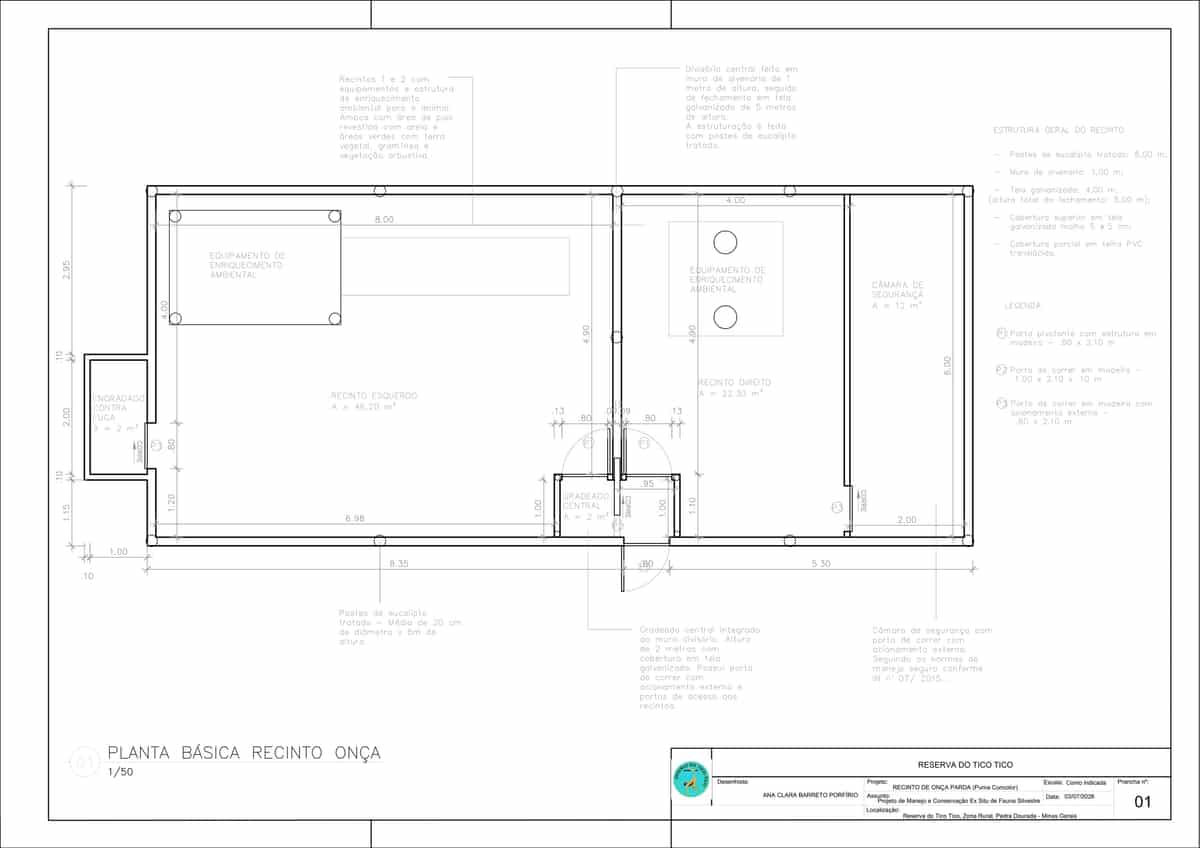
The enclosure project that grew out of his case is meant for pumas in general, not an enclosure built exclusively for him: Eliso may not be the one to move into it, if funding arrives after he's already found another placement. But pumas are a species that's rarely in short supply when it comes to needing a place — and the project already exists: two enclosures connected by a security chamber, with a suspended hideout and platform, a sand floor, and an expanded green area, designed in accordance with IBAMA Normative Instruction No. 07/2015. It was prepared for submission to IBAMA, the Minas Gerais state forestry institute (IEF), and CETAS Juiz de Fora — it's a technical document for an environmental agency, not marketing material.
Capacity to take them in
Help the reserve be ready to receive them
Neither project has a confirmed construction cost yet — this page will be updated as soon as it does. Until then, every donation to the reserve also sustains what's already built: the food, care, and veterinary attention for today's residents.